


DFG-Projekt: Prozesse von Ausschluss und Teilhabe aus schüler:innenbiographischer Perspektive (PATinklusio)
„Prozesse von Ausschluss und Teilhabe in inklusionsorientierten Schulen aus schüler:innenbiografischer Perspektive“ (PATinklusio)
gefördert durch die Deutsche Forschungsgemeinschaft (DFG) (Projektnummer 580821782)
Laufzeit: seit 10/2024
Übersicht
Projektbeschreibung
In diesem Vorhaben werden die Erfahrungen und Prozesse von Ausschluss und Teilhabe von Schüler:innen in sozial benachteiligten, behinderten Lebenslagen inklusionsorientierter Schulen aus einer schülerbiographischen Perspektive untersucht. Zentrale Fragestellungen dabei sind: Welche Prozesse, Mechanismen und Strukturen der Behinderung und Benachteiligung sowie der Ermöglichung schulischer Bildung innerhalb der Bildungsbiographien von Schüler:innen unterschiedlicher inklusionsorientierter Schulsettings lassen sich beschreiben und inwieweit lassen sich Unterschiede in den Erfahrungen von Ausschluss und Teilhabe zwischen Schüler:innen unterschiedlich sozial benachteiligter Lebenslagen rekonstruieren? Mit seinen Fragestellungen verbindet das Projekt die bislang eher getrennten Bereiche der erziehungswissenschaftlichen Schul- und Schülerbiographieforschung, Inklusionsforschung und Disability Studies. Für die Untersuchung bildet der biographietheoretische Ansatz den zentralen theoretischen Bezugsrahmen und wird um den intersektionalen Ansatz und das soziale und kulturelle Modellverständnis von Behinderung ergänzt. Methodisch stützt sich das Projekt vor allem auf biographisch-narrative Interviews mit Schüler:innen in unterschiedlich sozial benachteiligter, behinderter Lebenslagen (z.B. mit/ohne der Zuweisung eines sonderpädagogischen Förderbedarfs und oder das Aufwachsen in Armut) inklusionsorientierter Schulen. Experteninterviews mit Schulleitungen zu Fragen zum Schulkonzept und zu (sonderpädagogischen) Ressourcen dienen dazu, das Feld zu erschließen und zentrale Erkenntnisse über die schulstrukturellen Rahmenbedingungen zu erhalten. Es lässt als Ergebnis wichtige neue Erkenntnisse zur Relevanz des Besuchs inklusionsorientierter Schulen sowie zu differenzfördernden, exkludierenden wie auch differenzvermindernden Prozessen, Mechanismen und Strukturen verschiedener inklusionsorientierter Schulsettings erwarten.
Kontakt
Projektleiterin
Telefon: 0345-5523820
edina.schneider@paedagogik.uni-halle.de
Samplekonstruktion, Erhebungs- und Auswertungsverfahren
Untersucht werden 36 biografisch-narrative Interviews mit Schüler:innen in sozial benachteiligter Lebenslage in der 9. oder 10. Klasse an insgesamt sechs inklusionsorientierten Schulen mit unterschiedlichen Organisationsformen schulischer Integration und Inklusion in den Bundesländern Hamburg, Sachsen-Anhalt und Bayern (s. Tab. 1). Die Samplingbildung folgt einem mehrstufigen, kontrastiv angelegten Verfahren.
Die Auswahl der Bundesländer erfolgt vor dem Hintergrund unterschiedlich weit fortgeschrittener Entwicklungen schulischer Inklusion: Hamburg als inklusionsorientiert, Sachsen-Anhalt als entwicklungsambivalent und Bayern als strukturpersistent. Zudem werden verschiedene Organisationsformen schulischer Integration und Inklusion bei der Schulauswahl in dem jeweiligen Bundesland berücksichtigt, um strukturelle Kontraste systematisch einzubeziehen (u. a. präventiv sonderpädagogische Unterstützung, Sonderklassen, Schwerpunkt- bzw. Profilschulen, Kooperationsmodelle sowie Einzelintegration). Pro Schule werden vier bis sechs Interviews geführt, darunter drei bis vier mit Schüler:innen mit einem zugeschriebenem sonderpädagogischem Förderbedarf sowie zwei mit Schüler:innen ohne diesen.
Die Auswertung erfolgt entlang der retrospektiven Erschließung von „Prozeßstrukturen des Lebensablaufs“ (Schütze 2016), die die Möglichkeit bietet, die Prozesshaftigkeit von Erfahrungen und Veränderungen und damit die ‚Nachhaltigkeit‘ von unterschiedlichen Förder- und Schulsettings sowie pädagogischen Beziehungen im Sinne von deren Wirkung auf die schulisch-akademische und biografische Entwicklung von Schüler:innen über Zeit hinweg zu rekonstruieren. Es kann so in den Blick genommen werden, wie sich Übergänge gestalten, Erfahrungen von inklusiver und separater Beschulung sowie pädagogische Beziehungen auf einzelne Lebenswelten auswirken.
Ergänzend werden thematisch-strukturierte Expert:inneninterviews mit der Schulleitung zu Rahmenbedingungen und zur Ressourcenausstattung der Schulen realisiert, die inhaltsanalytisch (Mayring 2022) ausgewertet werden. Die Perspektiven der Schulleitung dienen vornehmlich der explorativen Felderschließung und Kontextualisierung der Schüler:inneninterviews und dazu, zentrale Erkenntnisse über die strukturellen Kontextbedingungen der jeweiligen Schule zu erhalten.
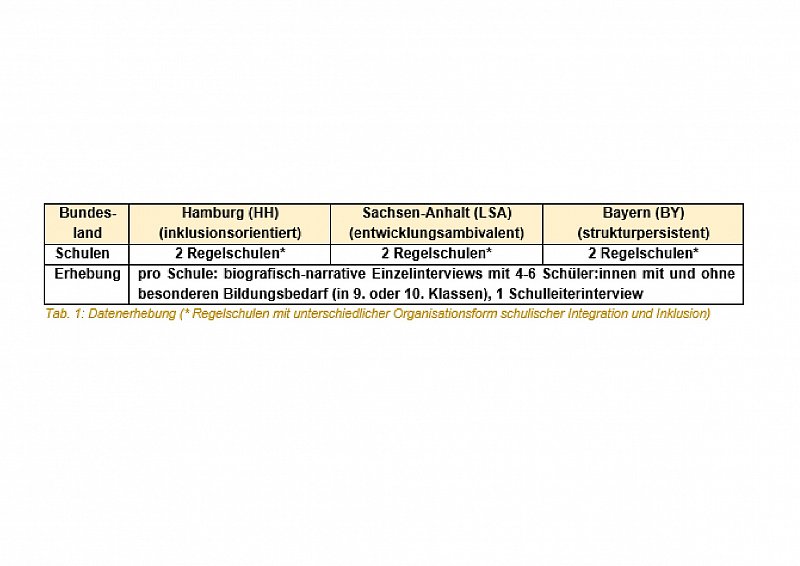
Tab.1: Samplekonstruktion
Publikationen
- Schneider, E. (i.V.). Zur Relevanz diffuser Strukturlogiken in Lehrer:innen-Schüler:innen-Beziehungen und Implikationen zur inklusive Schulgestaltung – eine theoretische und empirische Diskussion. In: Zeitschrift für Pädagogik.
- Schneider, E. (2026 i.E.). „keiner möchte so ne behindert sein, die möchten alle ein normales Leben führen“ – Jugendbiographische Perspektiven auf Normalitätsvorstellungen als Behinderungen sozialer und akademischer Teilhabe. In: Pfaff, N. et al. (Hrsg.). Jugende(en) im Spannungsfeld von Normativität(en) und Normalität(en). Reihe „Kindheits- und Jugendforschung“ VS Verlag.
- Schneider, E. (2025). "Sie kommt nicht wieder […] und da hab ich mich um mein Bruder gekümmert“ - Spuren der Situierungen von Solidarität und Sorge in schüler:innenbiographischen Erzählungen". In: Budde, J. et al.: Sorge und Solidarität. VS Verlag. 115-129. https://shop.budrich.de/produkt/sorge-und-solidaritaet/
- Schneider, E. (2025). "Förderschüler . behindert, kann nicht, das würd ich halt ändern" - Über schulische Inklusion als Zukunftsperspektive im Rahmen institutioneller Transformation - Eine schülerbiographische Perspektive. In: Schwendowius, D. et al. (Hrsg.): Ungewisse Zukünfte - Bildung und Biographie im Kontext gesellschaftlicher Umbrüche. Opladen: Barbara Budrich. https://doi.org/10.2307/jj.29010288.14